Material und Detail · 6 min
The Floor Transition as a Detail, Where Different Materials Meet
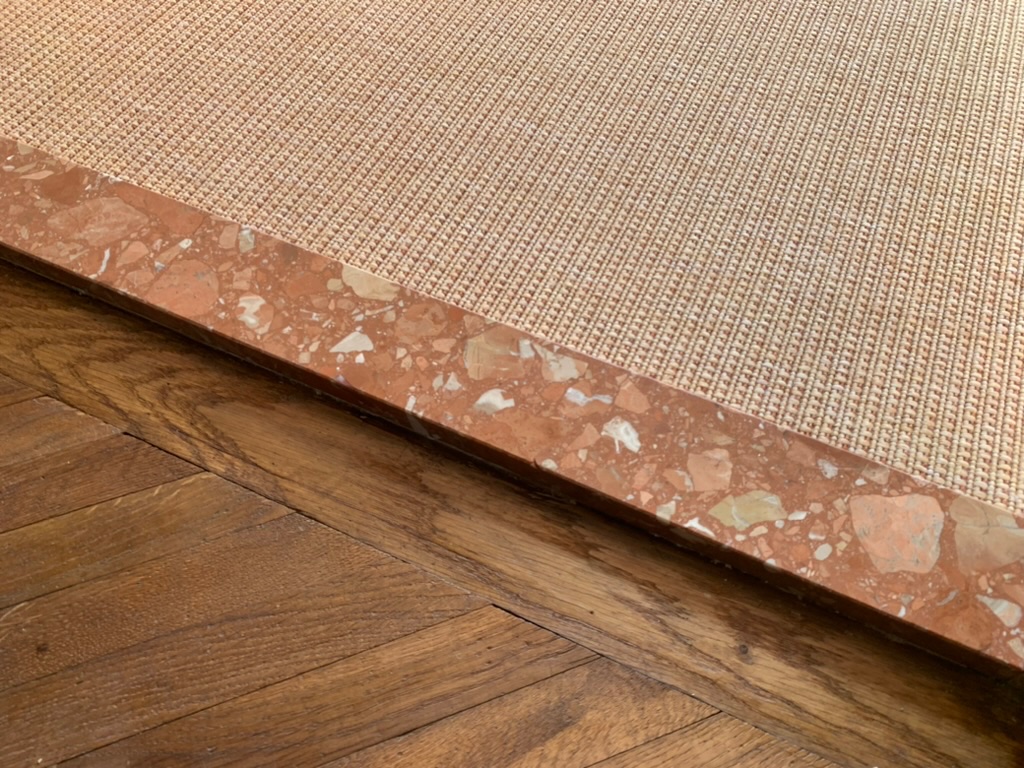
An edge of red marble lies flat between herringbone parquet and a coarsely woven sisal rug. It is not hidden, not bridged with an aluminium strip, but made into a material of its own. The red stone carries bright inclusions, small flecks that catch the light differently than the dark ground. A floor transition like this is the place where a room either becomes honest or fudges things. Here it becomes honest. Three materials meet, and none of them pretends to be another. That is exactly what makes the detail calm, long before you understand why.
Why the Floor Transition Decides the Whole Room
Floors speak quietly, but they speak a great deal. The first glance when you enter a room rarely goes up to the ceiling. It goes down, to where the foot wants to be. And there, at the threshold, it shows how carefully someone has thought.
In the photos you see a whole series of such places. There is the flat marble edge where parquet and sisal meet. There is the corner where the rug runs into a raw plaster and a pink painted pillar. And there is the strip of mirror that runs just above the floor and throws the sisal surface back once more. Each of these places is a transition. Each could have been hidden. None was hidden.
That is the real decision. You can treat a floor transition as a problem that has to go away. Or as a seam you are allowed to show. The second stance takes more courage, because a visible seam has to be clean. A hidden one forgives sloppiness. An open one does not.
Red Marble as a Threshold Between Parquet and Sisal Rug
The red marble in the first photo is no accidental stone. Its ground is warm, almost terracotta, run through with bright fragments and fine veins. A stone like this is a grown material, not an even covering. Every square centimetre looks different, and that makes it alive.
What it does here is the interesting part. On one side the herringbone parquet, oiled dark, with its own quiet order. On the other the coarsely woven sisal, light, almost sand coloured, edged with a warm border. Two very different textures. The marble lies between them like a breath. It belongs to neither and connects both nonetheless, because its red picks up the warm border of the rug and its veining recalls the liveliness of the wood.
That is the art of a good transition. It is not neutral, it mediates. A colourless strip would only have separated the two floors. This stone gives them a shared place. And because it lies flat, barely raised, you do not stumble over it, you only notice it.
When the Floor Meets Raw Wall and Painted Plaster
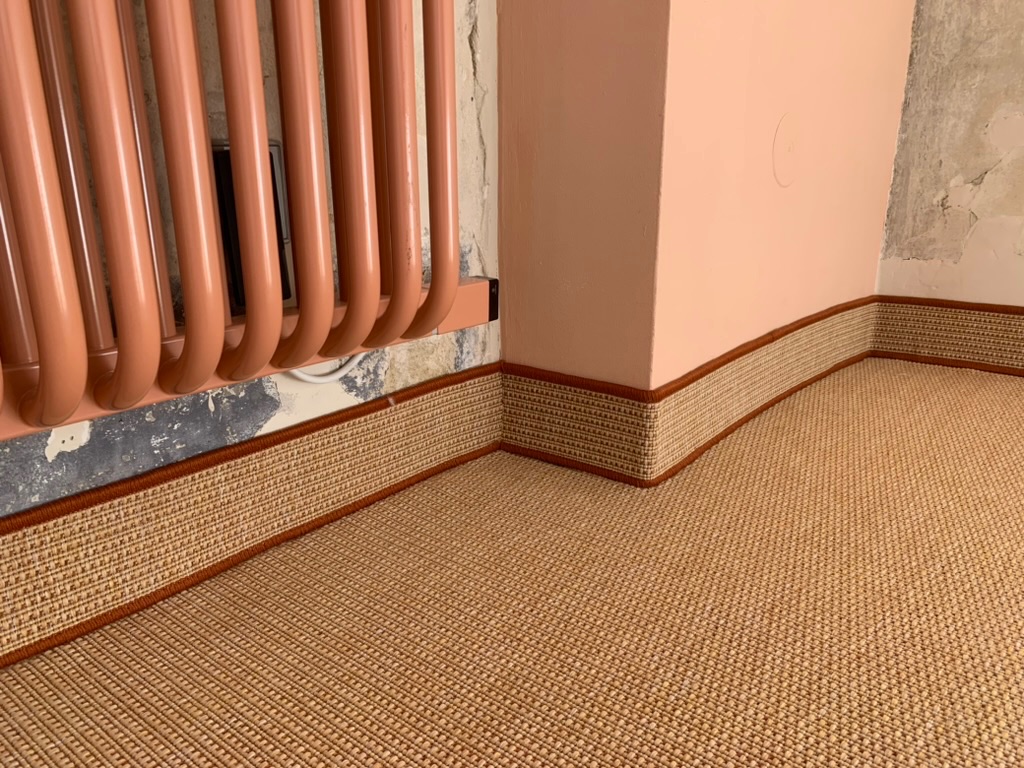
The third photo carries the story further, now upward. The sisal rug runs into the corner, cleanly edged with the red brown band that also climbs the wall as a slim skirting. Beside it a pink painted pillar. Behind it a raw wall with old, flaked layers of plaster and a radiator in the same warm tone as the floor.
Something happens here that is often done badly. The finished, soft rug meets the unfinished, hard wall. Normally a difficult encounter. But the colours hold it together. The pink of the pillar, the warm red brown of the skirting, the salmon coloured radiator, the sand coloured sisal. Everything sits in one family. Even the patchy, grey spot behind the heating pipes does not disturb, because so much around it is in tune that the raw reads as intention rather than oversight.
The textile skirting is the quietest and cleverest detail in all this. Instead of a wooden strip, the rug fabric itself climbs the wall, edged with the same border as the floor. The boundary between surface and wall almost dissolves. The room gains a soft foot.
The Mirror Strip at the Floor, a Quiet Trick With Material
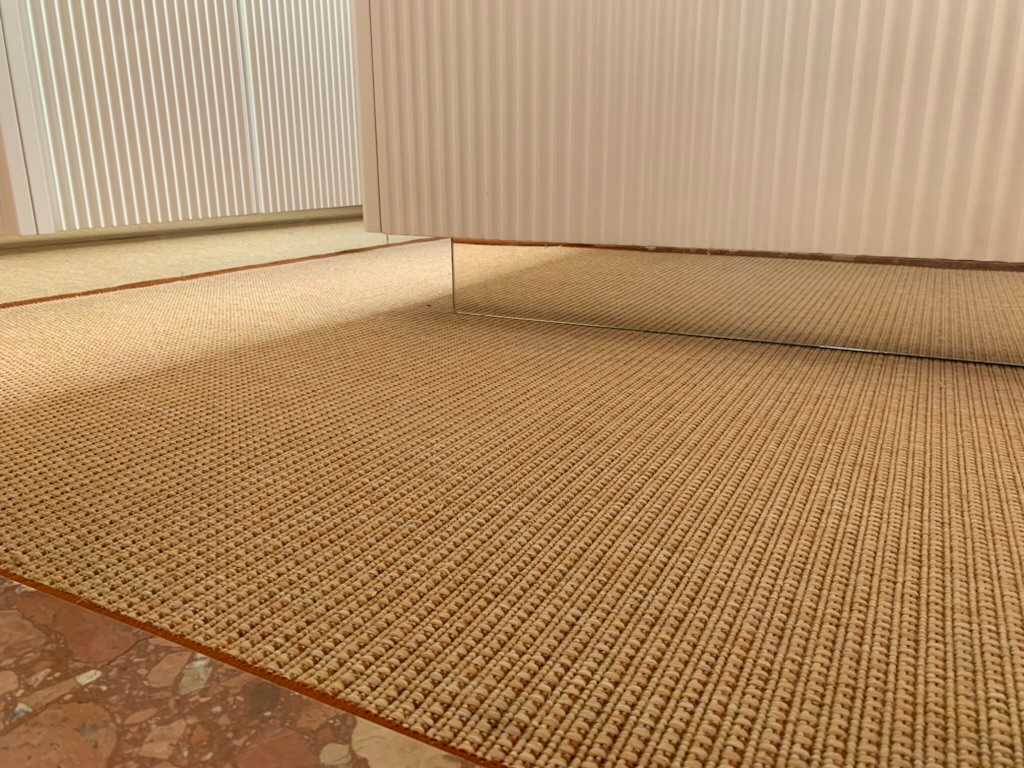
In the second photo a slim mirror strip runs just above the sisal floor, in front of a light, fluted front. It throws the rug back once more and lets the heavy surface float. An old device, used sparingly.
What interests me about it is the restraint. It is no large mirror, no effect for the effect's sake. Only a band, just tall enough to double the floor and bring a little light into the lower zone, which is otherwise always the darkest part of a room. The sisal gains air below it, even though it physically rests firm on the floor.
Details like this only work when they stay honest. The mirror feigns no second room, it only shows what is there anyway, a second time. That is the difference between a material that works and one that merely dazzles.
Many Materials, One Stance
When you lay the three photos side by side, a question surfaces that occupies many people as soon as they shape a room themselves. How many different materials can a floor, a room, an encounter bear before it grows restless.
The answer does not lie in a number. Here oak parquet, red marble, travertine in the background, woven sisal, painted plaster, raw plaster, lacquered metal and mirror all meet. That is eight materials in a tight space. And still nothing is loud. The reason is colour. Everything moves within a warm scale, from sand through salmon to red brown and the dark tone of the wood. The materials may differ, because the tones are related.
That is the real discipline. Not fewer materials, but a shared mood that carries them. A floor may be assembled by hand, with pieces that each have character of their own. It only has to have a sound in which they all appear. Once you have felt this in a room, you no longer miss the smooth, uniform solutions.
How such material conversations can be planned in detail, without becoming a collection, is shown in the work at martinarogy.com. And in our apartments you can see how a floor like this feels over weeks, not just in a photo.
How a Floor Detail Ages
The last thought is about time. A good floor transition is not made for opening day, but for the years that follow. Sisal wears down, it becomes lighter and smoother in well trodden spots. That is no damage, that is patina. Red marble gains a fine polish over time from feet, a depth no new stone has. Oak boards darken.
What matters is that the materials are allowed to age together. An aluminium strip does not age, it only grows dull and at some point falls apart. A marble strip becomes more beautiful. A textile skirting forgives knocks better than a lacquered strip, because it has no hard edge that chips.
That, in the end, is the measure for every detail at the floor. Will it look better in ten years or worse. Where the answer is better, someone has thought rightly. In these photos the answer is better at every seam.
Frequently asked
How do you best join two different floor coverings?
Instead of a neutral strip, a material of its own can mediate, such as a flat strip of marble or travertine. It picks up a colour tone from both floors and gives the seam a place of its own, rather than merely disguising it.
Does red marble go with a sisal rug?
Yes, when the tones are related. In the photos warm red lies beside sand coloured sisal with a red brown border. Both move within the same warm scale, which is why the encounter reads as calm rather than accidental.
How many materials can a room bear?
There is no fixed number. What matters is not the quantity but a shared colour mood. Eight different materials can read as calm if they all sit in the same sound, from sand through salmon to red brown.
Why a textile skirting instead of a wooden strip?
When the rug fabric itself climbs the wall, the boundary between floor and wall almost dissolves. The room gains a soft foot, and the skirting forgives knocks better than a lacquered strip, which can chip.