Material and Craft · 6 min
Fluted MDF Front, the Fine Groove as a Quiet Note in the Kitchen
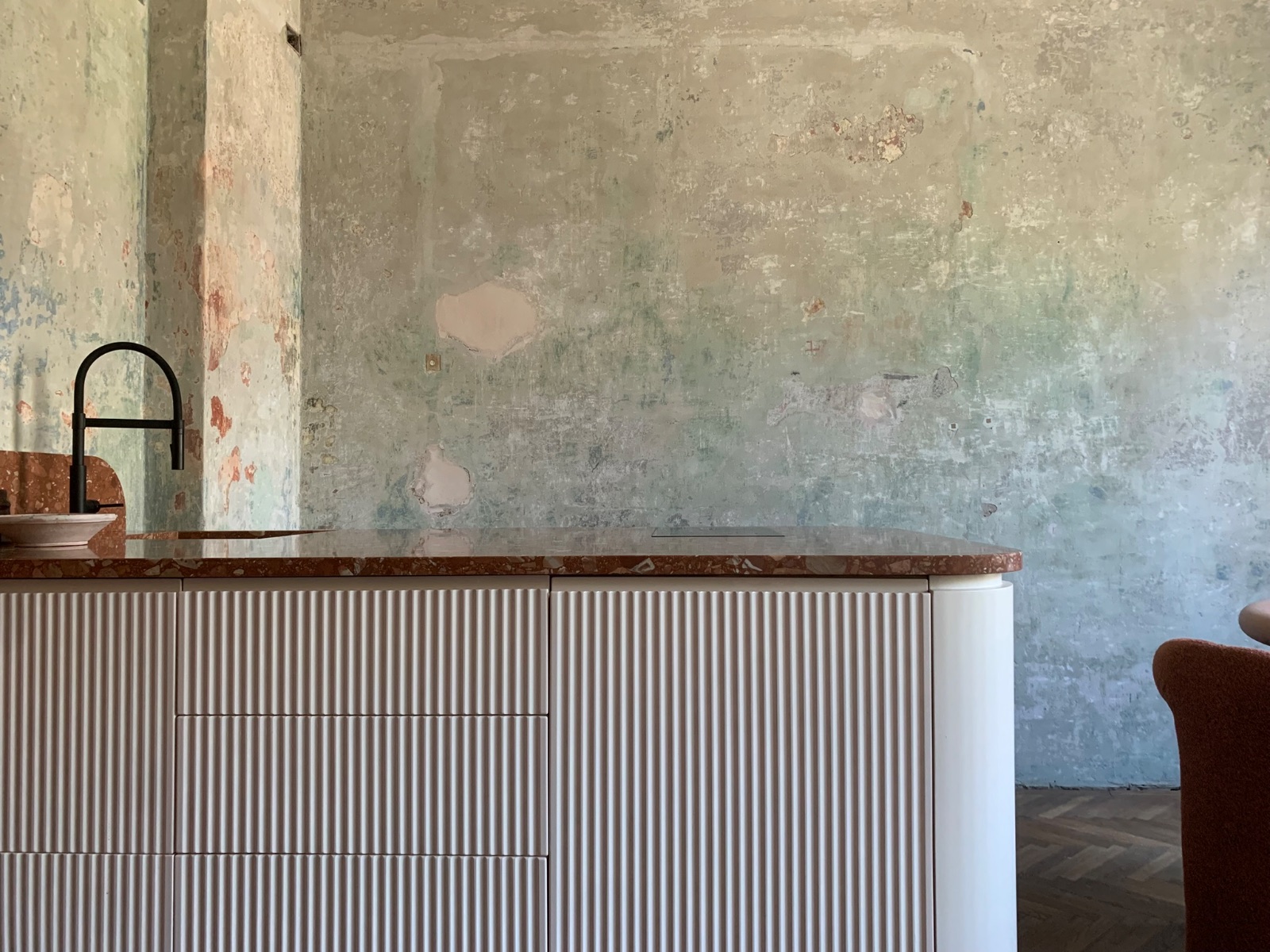
The light falls at an angle across the front, and suddenly the surface has a depth a flat board could never hold. A fluted MDF front turns a kitchen island into something other than a wall, into a play of slender shadows. Vertical grooves, set close together, in a warm, broken white. Above it a slab of red veined marble, behind it a wall of old lime plaster that shows every layer of its years. We love this moment because it claims nothing. The front works along quietly, it asks for no attention. That is exactly what concerns us here.
What a fluted MDF front does to a room
A flat kitchen front is a statement. It lies flat in the room, reflects hard and shows every fingerprint. The fluted MDF front does the opposite. The fine grooves break the light into many small lines, and what we see is not a mirror but a soft striped pattern that shifts with the hour of the day.
In the morning the light lies flat and the grooves cast long shadows. At midday the surface becomes almost even, calm and bright. In the evening, when only a single lamp is burning, the shadow withdraws again into the depth of the flutes. A front that moves without moving.
You can see this clearly in the photo. The island is large, it takes up space. But it does not press. The vertical lines stretch the body upward and give it an upright, almost textile character. Where a flat slab would stand as a block, here stands something that recalls a heavy curtain more than a piece of furniture.
MDF, an honest material without airs
MDF has a poor reputation, and that is unfair. The medium density fibreboard is no substitute wood, it is a material in its own right with its own strengths. It has no grain, no knots, no direction. That is precisely what makes it the ideal base for fluting. The grooves are milled, dense and even, and the surface carries every edge cleanly.
Painted or lacquered, MDF becomes a calm, matte surface with depth. The broken white in the photo is no cold pure white, it leans toward the warm, almost toward the sandy. This colour takes in the light rather than throwing it back. It also ages graciously. A matte lacquer surface gains its own patina over the years, it grows softer in tone, not worse.
We value material that is honest about what it is. MDF need not pretend to be solid wood. It can do what it can do. A fluted MDF front takes this honesty and turns it into something crafted. The milling is work, every groove is intended. You sense that, even if you could not name it.
The friction that holds it all together
What is interesting about this image is not the front alone. It is the friction. Above, a marble slab with strong red veining, a stone with character and history. Behind it a wall that was never finished, or deliberately laid bare. Lime plaster in many layers, greenish and pink patches, light gaps, old traces. A wall that has seen a great deal.
Between these two loud layers stands the fluted MDF front and mediates. It is new, but not intrusive. It is clear, but not hard. The fine fluting gives it enough texture to hold its own beside the raw plaster, and enough calm to let the marble speak.
This is the lesson we take from rooms like this. A room lives on friction, not on uniformity. Three perfectly matched flat surfaces would be dull. Here the new rubs against the old, the smooth against the raw, the geometric against the accidental. And precisely because the front is so restrained, it carries this tension without tipping over.
The black tap arch sets a clear, dark stroke into this play. A single hard note in a composition of soft ones. That too is intention. A detail that holds the eye before it wanders on.
Why fluting works in rooms lived in for a while
In our apartments we think a lot about surfaces, because people live here who come and go. A fluted MDF front has a practical advantage for this that you often notice only after weeks. It forgives. On a high gloss front you see every smear and every fingerprint. On a fine fluting that vanishes into the play of shadow.
Then there is the sound of the room. A flat, hard kitchen also reflects sound. Textured surfaces break it a little, and the room becomes minimally softer, friendlier. You do not hear it consciously, you feel it. A kitchen you like to stand in while making a coffee is also a question of acoustics.
And then there is character. Anyone living for a while in a foreign city does not want to land in a hotel drawer. A front with texture, a stone with veining, a wall with history. These are the things that make a room personal without anyone cluttering it. You can read more about our way of thinking about temporary living at LAROGY Apartments.
Thinking fluted fronts through properly, a question of measure
Fluting can quickly become too much. When every surface in the room carries a texture, things turn restless, and the eye finds no place to rest. In the photo this is solved well. Only the front is fluted. The slab, wall and floor stay smooth or randomly textured, but without repeating the pattern.
The width of the groove also makes a difference. Very fine grooves, as here, feel textile and calm, almost like a woven fabric. Wider profiles become more graphic, they emphasise the line more strongly and draw more attention. Both have their place, but they speak different languages.
The gently rounded corner of the island is a small, clever detail. It takes the hardness from the large form and lets the fluting run around the edge instead of cutting it off sharply. A curve feels inviting, you do not knock against it, neither with your hip nor with your gaze.
We are not giving a building manual here. Anyone seriously planning with such surfaces and material combinations will find more about the work behind it at martinarogy.com. For us it is about seeing. About understanding why an idea as plain as a milled groove can carry an entire room.
In the end the fluted MDF front is a good example of what we love about rooms that have grown. It does little and achieves much. It needs no gloss, no expensive gesture, no grand explanation. It stands there, catches the light in its slender lines and lets everything else in the room breathe.
Frequently asked
Is a fluted MDF front easy to care for?
On the smooth surfaces, yes. Over time dust gathers in the grooves, which calls for a little more attention than a flat front. In return, fingerprints and small traces all but disappear by themselves into the play of shadow in the fluting.
Does a fluted front not quickly feel restless?
Only if you use it everywhere. As the single textured surface in a room it brings calm rather than unrest, because the fine lines break the light softly. What matters is that the other surfaces, wall and floor, stay smooth or restrained.
Does a fluted MDF front suit raw plaster and marble?
It works especially well there. The plain, matte front mediates between the loud veining of the stone and the raw wall. It holds the tension between new and old without fighting for attention itself.